
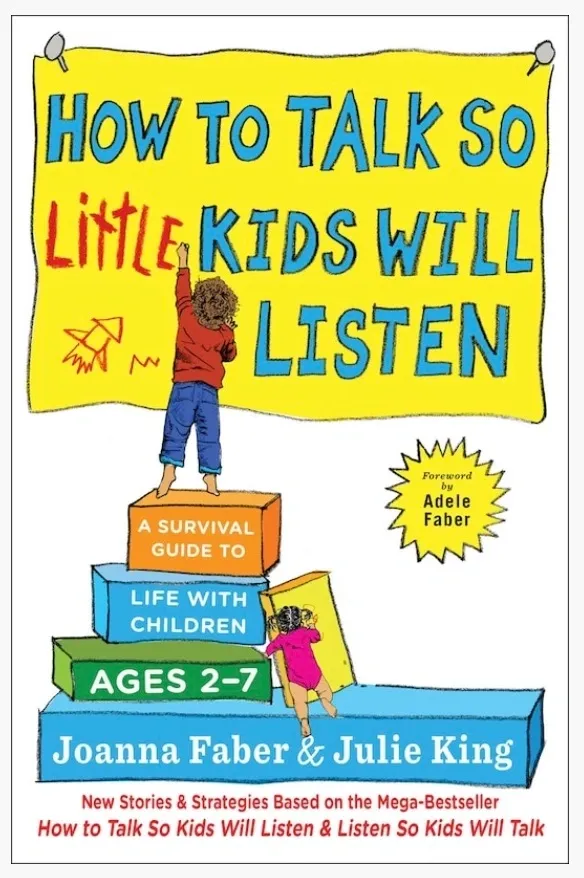
Busy Parents Quick Guide: How To Talk So Little Kids Will Listen
By Joanna Faber & Julia King
Summary
The book includes two parts. The book’s first part (i.e., the essential toolbox) provides an overview of various skills that will help children cope with their big emotions. On the other hand, in the second part of the book (i.e., tools in action), more detail is provided on how to use those tools in challenging situations (e.g., food fights, sibling rivalries). Tools and scenarios are presented throughout the book and followed by real-life examples of how those would undergo. I appreciate how the authors acknowledge that we, as parents, might get angry at our kids. They then proceeded to provide methods to address those instances with our children to make it a learning opportunity. This makes the book relatable, allowing me to integrate it into my life with my toddler.
Some of the main overarching themes were for parents to validate their children’s emotions, provide them with choices, and ensure our children’s basic needs are met. The authors also provide a chapter specific to atypical children. The tools provided in that section can also be helpful with neurotypical children.
One aspect of the book that I found more challenging is that they provided so many examples that it was hard to know which tools they were referring to. The authors provided a reminder at the end of each chapter summarizing the tools used, which was helpful. Below are my personal favourites.
Tool Example
- Acknowledge feelings with words “ Ugh a puzzle can be frustrating!”
- Put the child in charge “Johnny, would you set the timer and let us know when it’s time to leave?”
- Give information “Tissue go in the trash.”
- Describe how you feel “I don’t like food being thrown on the floor.”
- Describe progress “You sounded out each of the letters and you put them together. You read a whole sentence!”
- Take the time to imagine what your child is experiencing “So, to you the seams of the socks are very irritating!”
- Problem solving “It is not easy to remember all the things we must do in the morning. What do you think about having a chart.”